Why use VSM in DevOps?
DevOps is a culture where everyone is responsible for continuous delivery, from the planning and software development life cycles (SDLC) to production monitoring and continuous improvement. Basically, it’s more than a handoff: It is an ongoing, cross-functional approach, rooted in Agile and Lean principles.
Value streams are a visual tool that allows organizations to objectively measure and track what is most important to them and what they believe will actually bring value to customers in the end.
Here is a non-exhaustive list of why your DevOps teams should utilize VSM:
- Helps identify bottlenecks and pain points
- Manages errors and defects, such as bugs
- Creates greater visibility and traceability throughout the entire cycle
- Eliminates redundant and wasteful processes
- Fosters cross-functional collaboration
- Reveals opportunities for automation
- Fuels faster, integrated feedback
- Provides context and process clarity with data and visuals
- Emphasizes results and KPIs
Use value streams to gain insight and guide necessary improvements to ensure you have the bandwidth to support functionality and the documentation to put it into place.
How to use VSM in DevOps
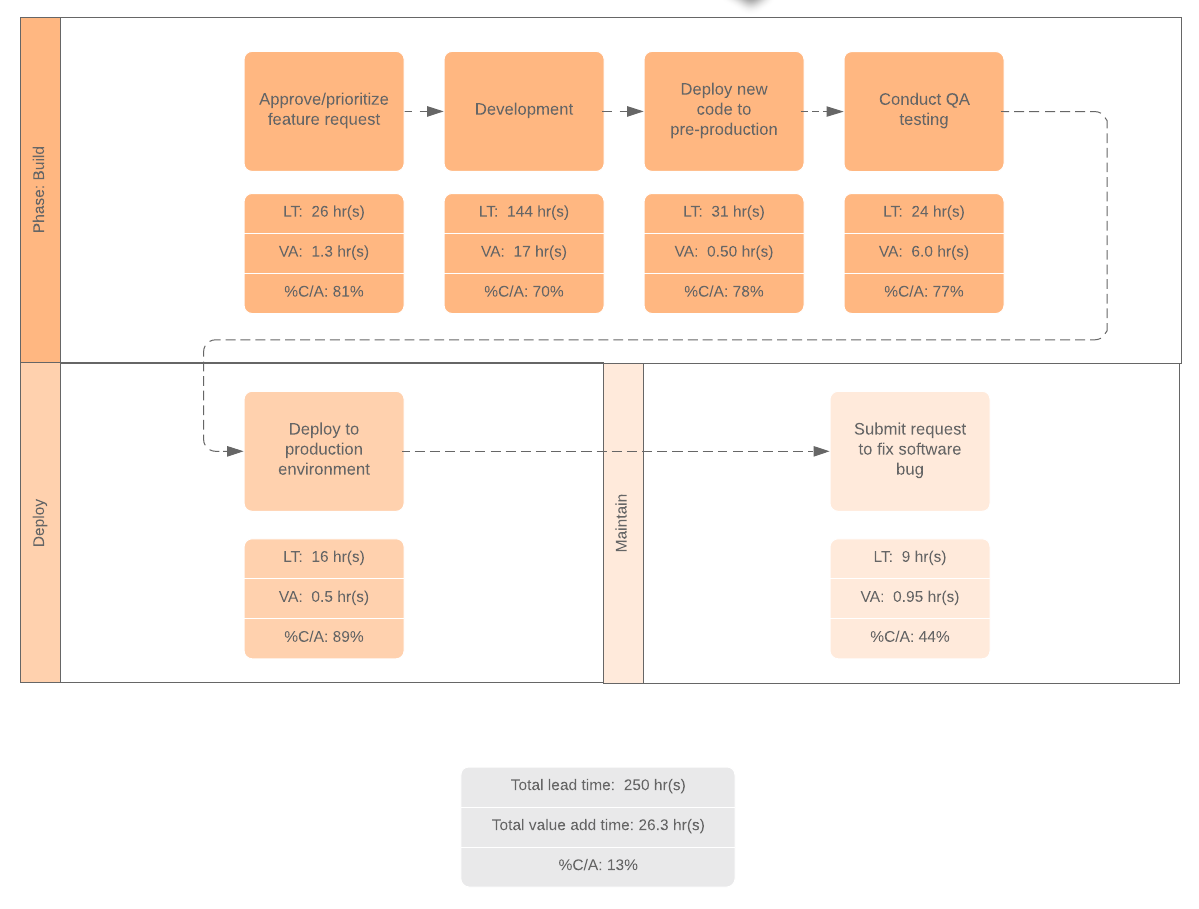
In a DevOps environment, VSM and lean methodologies are tailored to specific actions, such as moving work between teams to creating tangible deliverables and incident reports. DevOps VSM is a uniting visual representation of how IT and business build, deploy, and manage workflows. It should begin with the SDLC and move through quality assurance and release/operations.
The stream should delineate everything between your start and finish points, from product development to deployment and beyond. Build your diagram using key metrics to determine how you define and measure success so you can iterate and continuously improve.
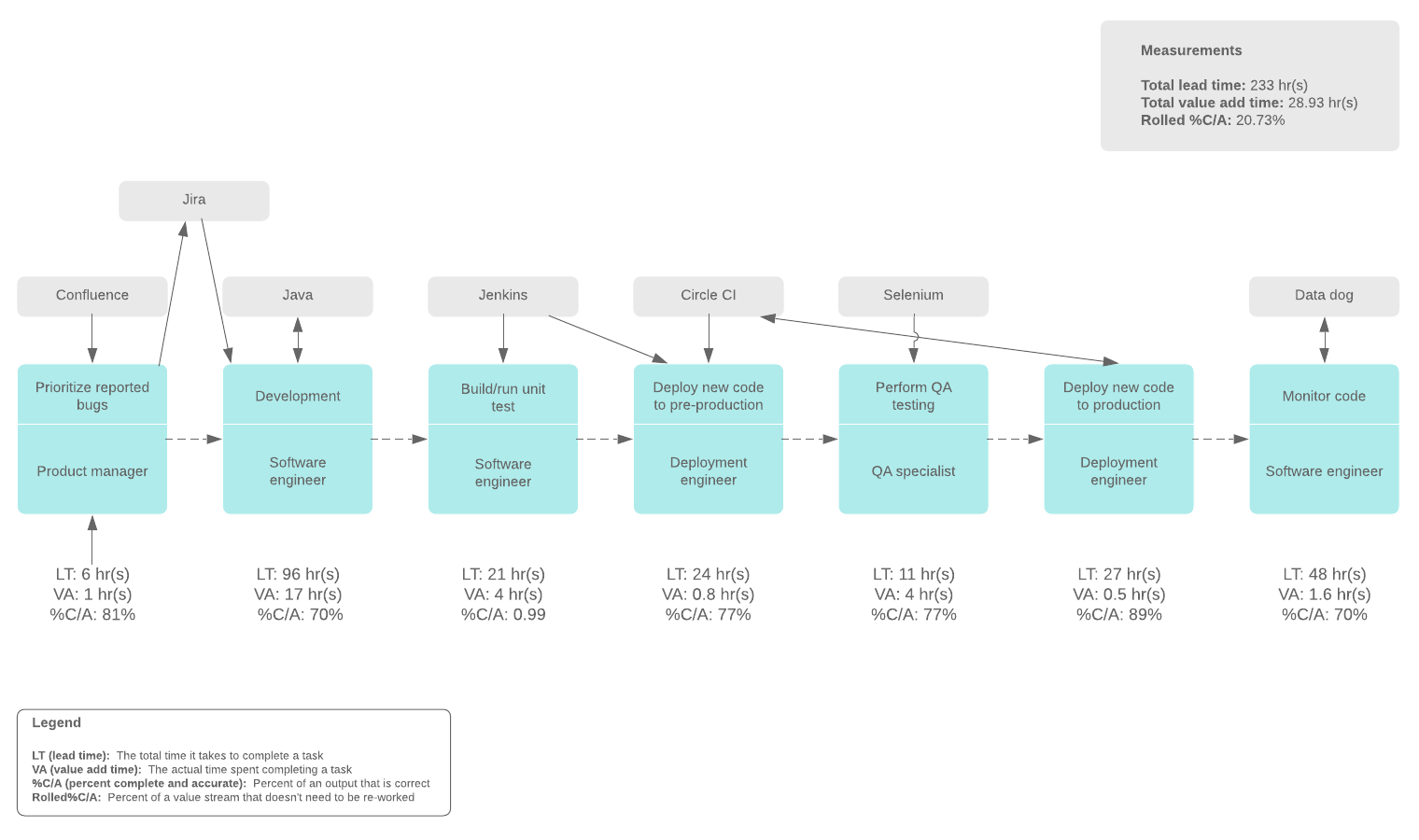
Lean and Six Sigma principles suggest measuring things such as value added time and lead time. In a DevOps environment, exactly what you measure and how you measure it will naturally look a little different than traditional uses. However, you can still use the suggested metrics, simply tailored to your own domain. Here’s a quick overview of the three key components:
Value added (VA)
Value added time is the amount of time that a team actually spends working on the project (as opposed to, for example, the time that a project or request sits in the queue). Whenever there is no change in the product, it is considered non-value added time.
Lead time (LT)
Lead time represents the total time it takes a person or team to complete a task—it is the combination of value added and non-value added.
% Complete/accurate (%C/A)
This is the percentage of information-based work that is complete and accurate the first time and requires no re-work by downstream processes.
Now, you can actually get started. Build your own data-driven stream by following these four steps:
- Map out your as-is DevOps stream
- Identify waste
- Build your to-be DevOps stream
- Communicate change to your organization
To get started, you can use the Lucidchart platform to build, analyze, and share your work in all stages with developers, QA, and stakeholders for better understanding all around. Quickly message DevOps channels or individuals using the Lucidchart Slack integration, or even give diagram access to keep stakeholders up to date through the cycle.
Let’s take a closer look at each of the steps:
Map out your as-is DevOps VSM
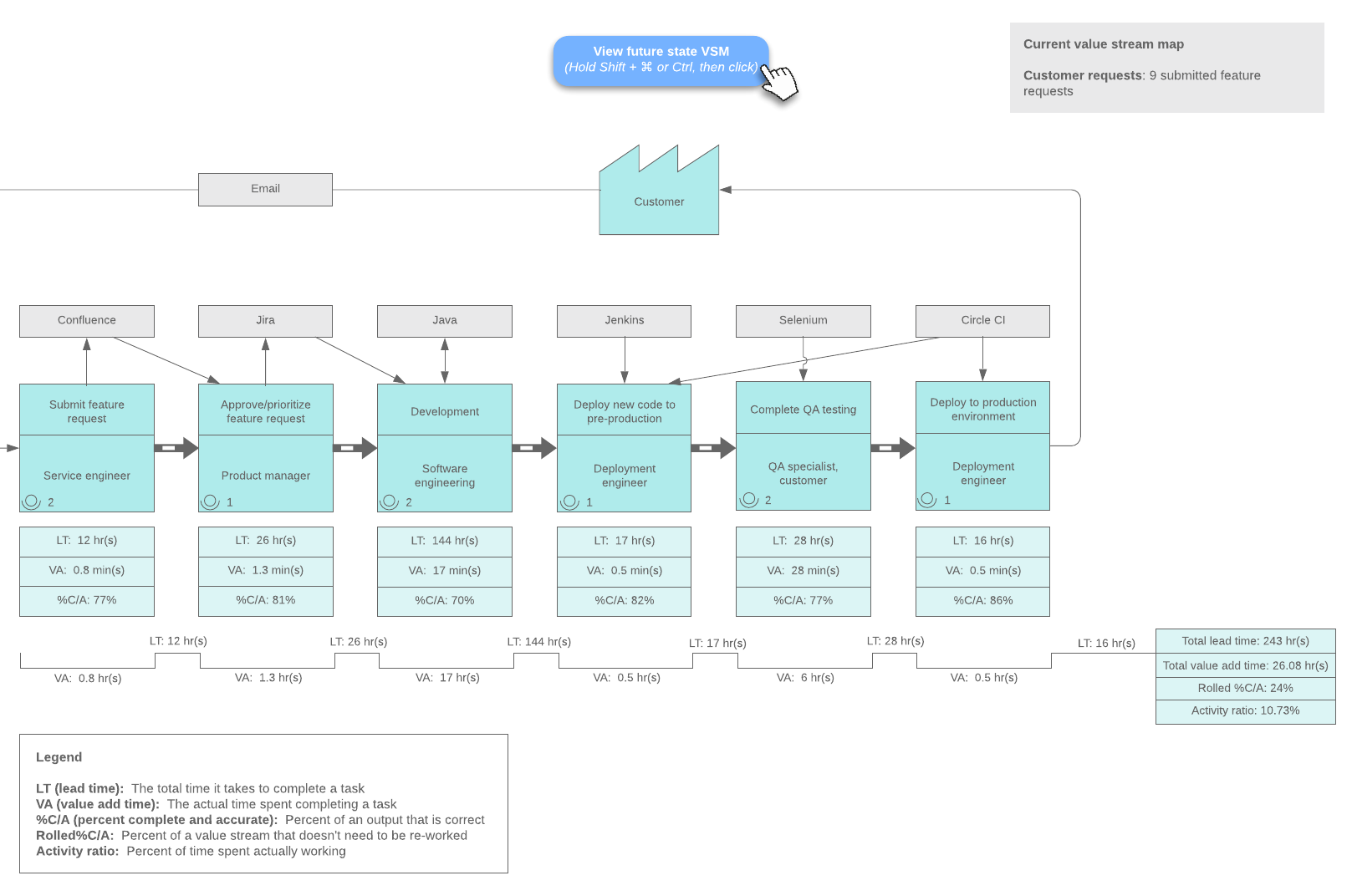
While we want to quickly implement new and improved processes, it’s crucial to build your as-is DevOps value stream early in the process to guide your future state and ensure you deliver what the customer needs, when they need it.
Your stream will likely be complex, but you can easily visualize your current state using Lucidchart, which offers all the shapes you need to get started, such as process, material, information, and general shapes.