Log in

All about muda, mura, and muri

Reading time: about 4 min

Topics:

  • Process improvement

Key takeaways

  • Muda, mura, and muri are the foundations for lean operations. The three M’s explain types of waste that can occur within an organization. Muda encompasses waste as a whole, mura explains unevenness in an operation, and muri translates to overextending resources.Ā 

  • There are eight types of waste: transportation, inventory, motion, waiting, overproduction, overprocessing, defects, and skills.

  • To eliminate waste, clarity is key. Clearly map your processes and document projects to visualize workflows, prevent wasted resources, and achieve alignment.Ā 

Throughout history, successful businesses have consistently prioritized operational efficiency. No matter the industry, the goal is the same: deliver maximum output with minimal friction. This is the core of lean processes.Ā 

The Toyota Production System (TPS) has been credited with developing some of the first Lean methodologies that have been adopted worldwide. The three M’s: muda, mura, and muri, are foundational to Lean methodology. They describe different causes and categories for waste. By eliminating muda, mura, and muri, companies can maintain a high level of operational excellence, increase productivity, and improve quality.

This article will explain muda, mura, and muri and how eliminating waste will help you protect the bottom line.Ā 

Explore six process improvement methods and when to use them.

Read more

What are muda, mura, and muri?

The three M’s are used together to identify and eliminate waste. Let’s explore them more below.

Muda

Muda is the Japanese word for waste. Waste is defined as any activity that takes up more resources than the value it adds. Six Sigma and Lean manufacturing have identified eight types of waste, represented by the acronym TIMWOODS.Ā 

  • Transportation: Unnecessary movement of materials

  • Inventory: An excess of raw materials or finished goods that takes up space

  • Motion: Unnecessary movement from people searching for tools or information

  • Waiting: Idle time spent when workers or items are waiting for the next step or approval

  • Overproduction: Producing items or doing work before it is needed

  • Overprocessing: Doing more work than is needed

  • Defects: Rework due to mistakes

  • Skills: Underutilizing workers

Example of muda: The content marketing team finished the copy for an email campaign and sent the file over to the email team for approval. However, the manager of that team was on vacation, so the file sat for a few days until it was reviewed (waiting). Once the files were reviewed, the manager asked if the content team could make some edits based on new priorities and sent the files back over (transportation). Because the deadline is fast-approaching, the content writer now has to act swiftly, meaning that their current projects must wait while they adapt the content to changing stakeholder needs (defect and motion).

Mura

Mura is described as unevenness, fluctuation, or variation within an operation. This irregularity is a direct cause of waste (muda) and can lead to a plethora of struggles: overproduction, idle time, inconsistent quality, and more. To avoid unevenness, it is important to implement solid project management techniques that will help stabilize your workflow.Ā 

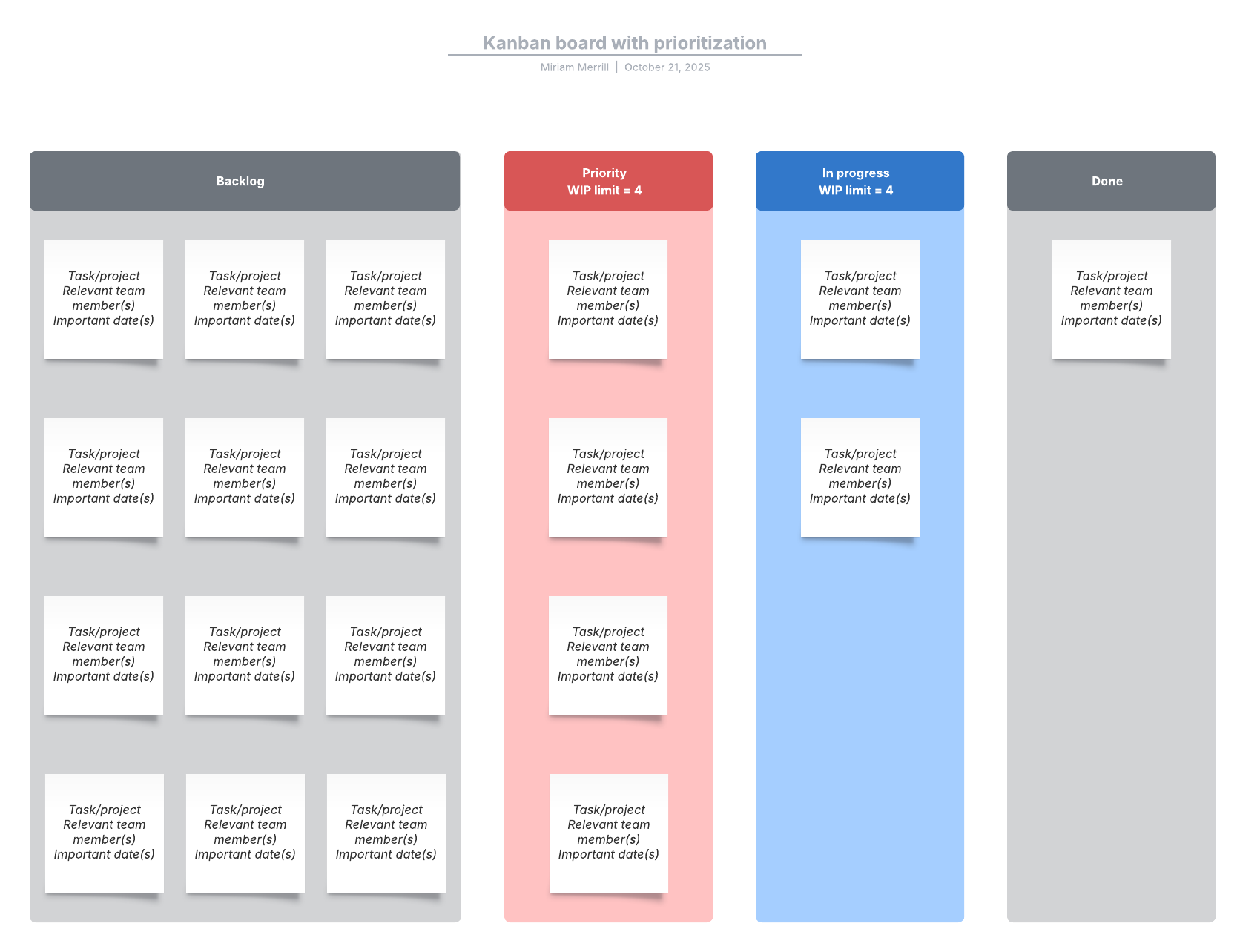
For example, Kanban methodology is an excellent project management tool, as it helps limit overproduction and balance bandwidth across your team.Ā 

This Kanban board with prioritization template is available for team and enterprise users.

Example of mura: Imagine a social media team that doesn’t have a standardized calendar. Initially, they have a large content backlog, meaning they don’t need to create new posts for several weeks. But as the backlog thins, the team frantically rushes to create new content. They are forced to create hurried work to meet an impossible deadline, resulting in careless errors, panic, and frustrations.

Muri

Muri means to overburden or to add unreasonable strain. It explains the stress placed on resources such as equipment, people, or systems, beyond maximum capacity. When entities have excessive load, failure is almost always guaranteed. Rushing processes inevitably wastes more time and resources.Ā 

The best defense against muri is clarity. By mapping out and standardizing your processes, you can visualize your workload and determine your team’s true maximum capacity. This helps you create reliable workflows that are predictable and mindful of your resources.Ā 

This capacity planner template is free to all Lucid users.

Example of muri: A truck can effectively carry 50 pallets of tomatoes. But the grocery stores are in high demand for them this season, so the packers decide to increase the freight to 60 pallets. Overburdening the truck compromises the safety of the driver and the cargo and increases the risk of a breakdown, ultimately taking longer to deliver the fruit to the stores. Not only does this result in time wasted, but now the truck needs repairs.

Lucid empowers teams to clearly map systems and processes, revealing areas of improvement. Teams can brainstorm solutions in Lucidspark, then build future states in Lucidchart. By leveraging dynamic visualization capabilities along with efficient project management tools, you and your team gain the power to identify and eliminate muda, mura, and muri. The result is strong alignment, less team burnout, and more sustainable processes.

Clearly map your processes to identify areas for optimization and eliminate waste.

Read more

About Lucidchart

Lucidchart, a cloud-based intelligent diagramming application, is a core component of Lucid Software's Visual Collaboration Suite. This intuitive, cloud-based solution empowers teams to collaborate in real-time to build flowcharts, mockups, UML diagrams, customer journey maps, and more. Lucidchart propels teams forward to build the future faster. Lucid is proud to serve top businesses around the world, including customers such as Google, GE, and NBC Universal, and 99% of the Fortune 500. Lucid partners with industry leaders, including Google, Atlassian, and Microsoft. Since its founding, Lucid has received numerous awards for its products, business, and workplace culture. For more information, visit lucidchart.com.

Related articles

  • Lean methodology 101

    In this article, we’ll discuss how the Lean methodology can help you to improve productivity, eliminate waste, and keep your customers happy.Ā Ā 

  • 5 Lean Six Sigma principles you should adopt immediately

    Combine two of the most prominent project management methodologies, and what do you get? Lean Six Sigma. Learn more about the method that can both eliminateĀ waste and reduceĀ defects in your company's workflow.

  • Single-Minute Exchange of Dies: Improving lean operations

    Keep reading to discover what SMED is, why it is beneficial, and how to use the SMED process to improve operations within your organization.Ā 

  • Scrum board vs Kanban board: Choosing the right Agile tool

    Not sure whether a Scrum board or KanbanĀ board is best to help your development team build and release quality products faster?Ā Learn what a Scrum board is and how it differs from a Kanban board.

Bring your bright ideas to life.

Sign up free
Sign in with GoogleGoogleSign in with MicrosoftMicrosoftSign in with SlackSlack

By registering, you agree to our Terms of Service and you acknowledge that you have read and understand our Privacy Policy.

Get started

  • Pricing
  • Individual
  • Team
  • Enterprise
  • Contact sales
PrivacyLegalCookie privacy choicesCookie policy

Ā© 2026 Lucid Software Inc.